
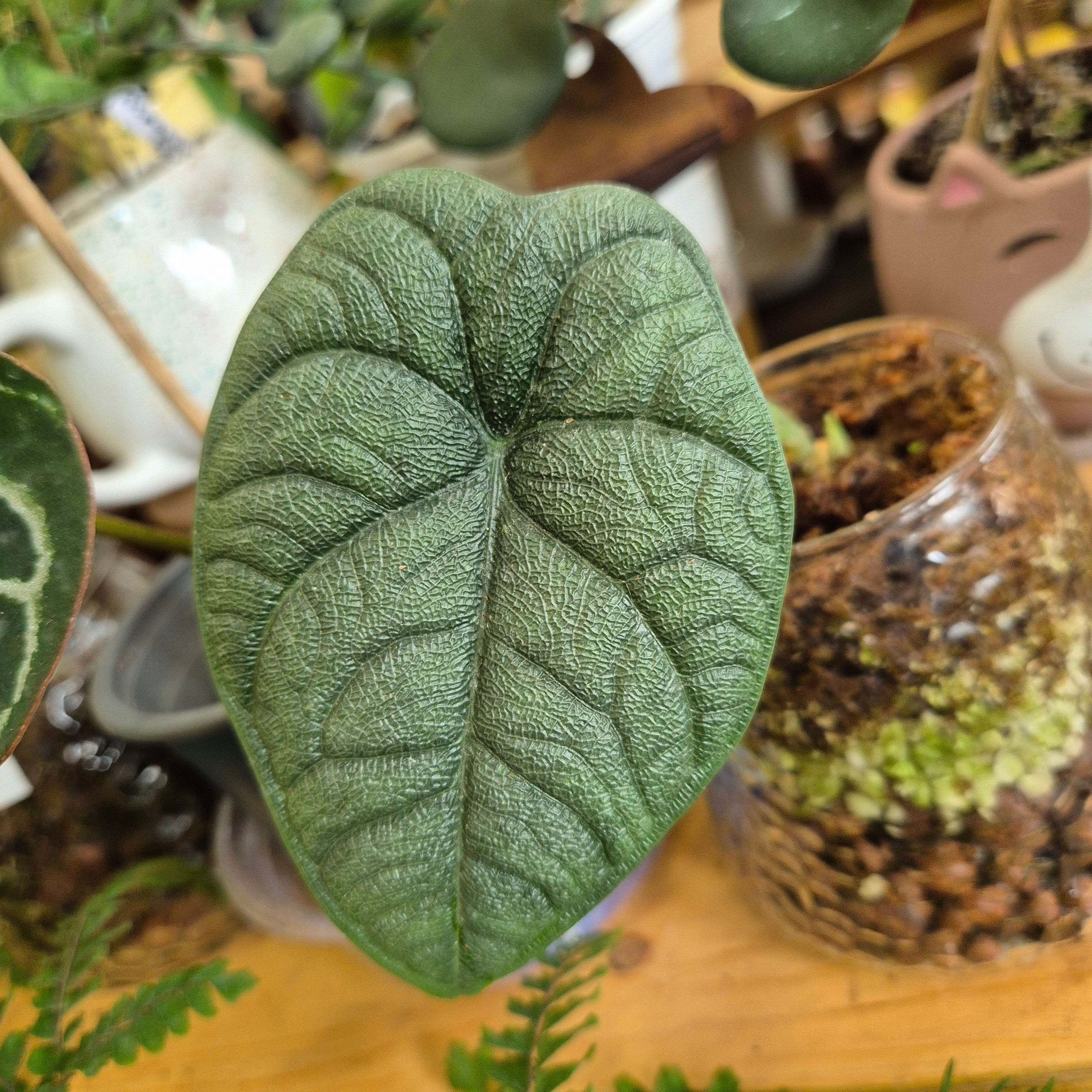

Alocasia rugosa 'Melo'
🌿 The Alocasia rugosa 'Melo', commonly called the Melo Alocasia or Jewel Alocasia, belongs to the Araceae family and represents one of the most tactile species in the Alocasia genus. Native to the limestone karst formations of Borneo, this tropical perennial thrives in the filtered light beneath the rainforest canopy where humidity hovers near saturation. In its natural habitat, it grows as a compact terrestrial plant among rocky outcrops, developing thick, leathery leaves with deeply textured surfaces. This is an intermediate-level plant that rewards attentive care with stunning foliage. Here's something fascinating: the deeply pitted texture of its leaves mimics the surface of a cantaloupe melon, which inspired its common name and makes each leaf feel like embossed leather.
FOLIAGE AND GROWTH HABIT
This compact upright grower produces leaves that emerge tightly rolled before unfurling into broad, heart-shaped blades. The foliage displays a rich forest green to blue-green colour with prominent veining that creates a quilted, three-dimensional surface. Each leaf feels remarkably thick and leathery to the touch, with deep pitting and ridges that give it an almost sculptural quality. The texture is so pronounced that running your fingers across the surface feels like touching fine embossed fabric or the rind of a melon.
FLOWER DETAILS
Like most Alocasias grown indoors, the Melo can produce typical aroid flowers consisting of a pale green to cream-coloured spathe wrapped around a central spadix. The blooms carry no significant fragrance and appear only occasionally when the plant reaches maturity and experiences ideal growing conditions. While the flowers hold botanical interest, the true aesthetic appeal of this plant lies entirely in its remarkable foliage. Flowering is relatively rare in home environments, and some growers actually remove emerging flower spikes to redirect the plant's energy back into leaf production. If you want to encourage blooming, maintain consistently warm temperatures above 20°C, high humidity, and provide the plant with regular feeding during the active growing season.
CARE INSTRUCTIONS
- 🌞 Light: Bright indirect light works best, avoiding direct sun which can scorch the leaves. Tolerates partial shade but growth slows considerably. Aim for 6-8 hours of filtered light daily, such as near an east-facing window or a few feet back from a south-facing exposure.
- 💧 Water: Keep soil consistently moist but never waterlogged during spring and summer, allowing the top 2-3 cm to dry between waterings. Reduce frequency in autumn and winter when growth slows. Water when you insert your finger and the soil feels barely damp. Bottom watering or careful top watering works well, ensuring water drains completely from the pot.
- 🌡️ Humidity: Requires high humidity between 60-80% to prevent leaf edge browning and maintain that gorgeous texture. Use a humidifier, pebble tray, or group with other tropical plants.
- 🪴 Soil: Needs a chunky, well-draining mix with excellent aeration. Combine orchid bark, perlite, peat or coco coir, and a bit of activated charcoal for a structure that holds some moisture while preventing compaction.
- 🏺 Potting: Choose a pot with drainage holes, slightly snug rather than oversized, in terracotta or plastic. Depth matters less than width for the rhizome to spread. Repot every 18-24 months in spring when roots fill the container or growth slows.
- 🌱 Growth rate: Moderate to slow, producing 2-4 new leaves over six months under good conditions. After one year, expect a plant roughly 30-40 cm tall and wide. Maximum mature size reaches about 45-60 cm in height with similar spread indoors.
- 👩🌾 Fertilizing: Feed every 3-4 weeks during spring and summer with a balanced liquid fertilizer diluted to half strength. Reduce to monthly in autumn and stop in winter. An all-purpose 20-20-20 or similar formulation supports healthy growth without salt buildup.
- 🐾 Pet friendly: No. All parts of this plant contain calcium oxalate crystals which are toxic to cats, dogs, and other pets if ingested. Symptoms include oral irritation, excessive drooling, vomiting, and difficulty swallowing. Keep well out of reach of curious animals.
WHERE TO PUT IT
The Alocasia rugosa 'Melo' thrives in bright bathrooms with natural light where ambient humidity stays elevated, or in living rooms and bedrooms near humidifiers or grouped with other moisture-loving tropicals. A spot within a few feet of an east or north-facing window provides ideal light without harsh rays. It also does beautifully in a dedicated plant room or greenhouse cabinet where you can control conditions precisely. Avoid placing it in drafty hallways, near heating vents, air conditioning units, or in rooms with temperature swings. Keep away from direct afternoon sun streaming through west or south windows, as this will fade and damage the leaves. Low-light corners and basements lack sufficient brightness for this species.
common
