
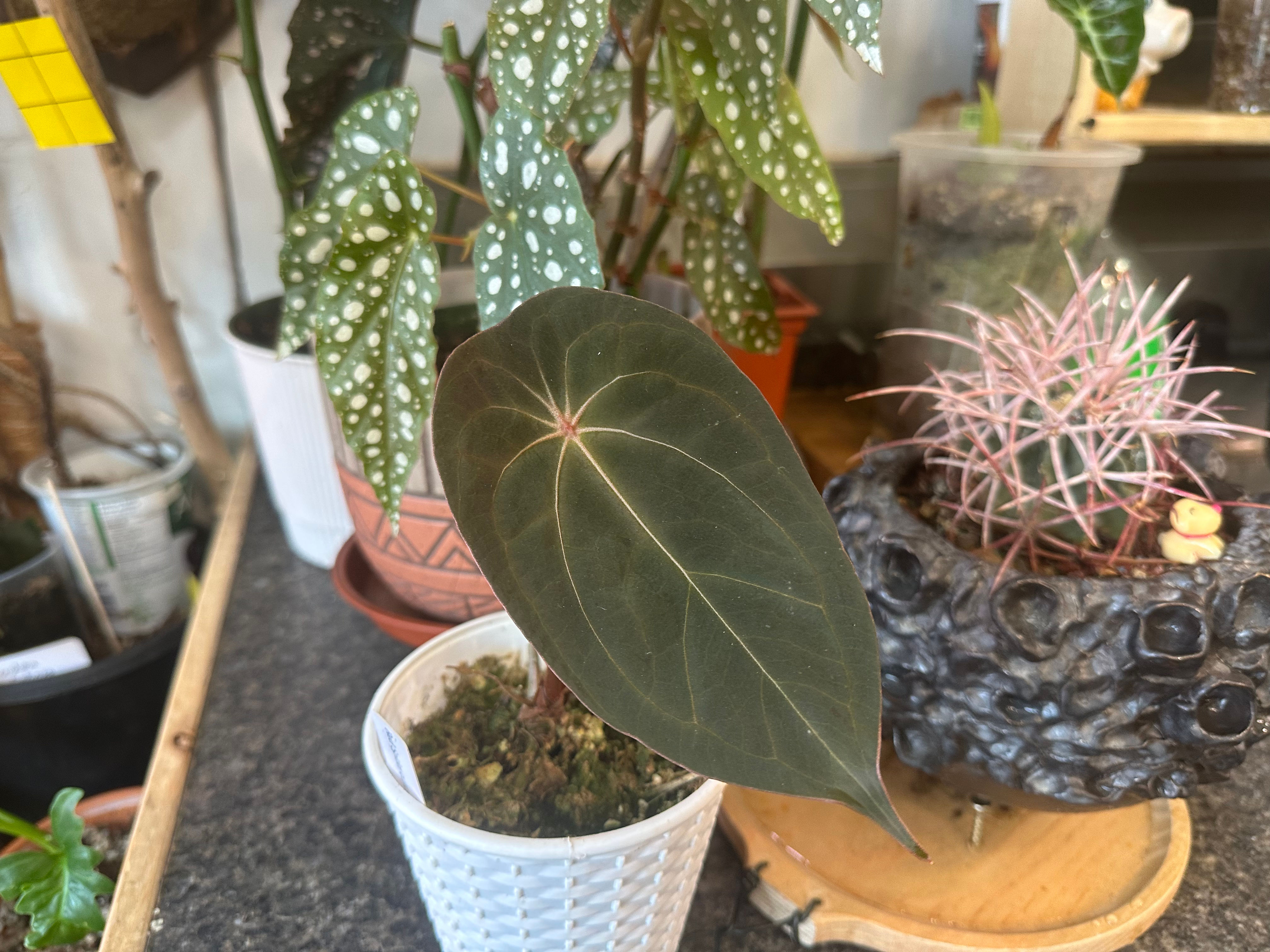

1.1. Anthurium Red Spider 6436
🌿 Anthurium 'Red Spider' is an impressive hybrid cultivar belonging to the tropical arum family, Araceae. The parent genus Anthurium is native to the Neotropical rainforests of Central and South America, where wild species grow as epiphytes anchored to canopy boughs, lithophytes on steep moss-covered rock faces, or terrestrial herbs across the moist rainforest floor. Cultivated as an exclusive collector-grade foliage plant, this selection is distinguished by its elongated, spider-like leaf silhouette featuring slender basal lobes, a pronounced open sinus, and striking reddish to copper emergent pigmentation that matures into deep forest-green leathery foliage.
FUN FACT
After successful pollination, Anthurium flowers develop into juicy berries that vary in color and usually contain two seeds.
FOLIAGE AND GROWTH HABIT
Anthurium 'Red Spider 6436' displays an architectural, semi-erect growth habit, developing a sturdy short central stem that supports long, arching petioles. In mature indoor container specimens, the plant achieves a height of 50 to 75 centimetres with an equal foliar spread. The leaf blades are narrowly sagittate to lanceolate-hastate, measuring 30 to 55 centimetres in length and 12 to 20 centimetres across at their widest point. The basal lobes are slender, elongated, and gracefully pointed, giving the leaf blade its characteristic arachnid-inspired appearance. Leaf texture is firm, coriaceous, and semi-glossy, featuring prominent primary lateral veins that branch outward like an intricate web. When new foliage emerges, it unfurls in a luminous shade of rich reddish-bronze or dark crimson, infused with anthocyanin pigments that protect tender growing cells from light stress. Over several weeks, this vibrant coloration gradually transitions to a deep, dark emerald-green. Robust, grooved petioles provide rigid structural support, while adventitious aerial roots frequently emerge from lower stem nodes to seek atmospheric moisture.
FLOWER DETAILS
Mature specimens produce inflorescences intermittently during the warm spring and summer seasons. The inflorescence is borne on a stiff, upright peduncle that holds the bloom prominently beside the foliage. The spathe is slender, lanceolate, and recurved, displaying a greenish hue often suffused with reddish-brown or purplish tones along its margins, measuring 8 to 14 centimetres in length. Rising from the spathe base is a slender, tapering spadix measuring 10 to 18 centimetres long, densely covered with tiny bisexual flowers arranged in tight geometric spirals. The spadix exhibits protogynous flowering, wherein receptive female stigmas secrete clear stigmatic droplets before male stamens release pale yellow pollen. After successful cross-pollination, the spadix swells gradually into a cluster of fleshy, berry-like fruits containing small seeds.
CARE INSTRUCTIONS
- 🌞 Light: Thrives in bright, filtered indirect illumination. An unobstructed east-facing exposure or bright north-facing window provides optimal light levels without thermal stress. Protect foliage from direct midday sun, which can scorch the leaf margins and dull the vibrant emergent coloration.
- 💧 Water: Maintain a gentle, consistent moisture level in the substrate. Water thoroughly when the top third of the potting mix feels dry to the touch, allowing water to flow freely through the drainage holes. Avoid allowing the root zone to dry out completely or sit in standing water.
- 🌡️ Humidity: Prefers elevated ambient humidity between 60% and 75%. While adaptable to average household conditions during summer, supplemental humidity from a humidifier or pebble tray is beneficial during dry winter heating periods.
- 🪴 Soil: Requires a coarse, highly aerated tropical aroid blend consisting of 45% medium-grade pine bark, 25% coarse perlite or pumice, 15% coconut coir chunks, 10% horticultural charcoal, and 5% organic worm castings for optimal root respiration.
- 🏺 Potting: Best grown in a sturdy container with generous bottom drainage holes. Unglazed terracotta, porous ceramic, or heavy plastic nursery pots work admirably. Repot every 18 to 24 months in early spring to refresh the chunky substrate and accommodate root expansion.
- 🌱 Growth rate: Moderate grower, consistently unfurling fresh leaves every 6 to 9 weeks during active warm-season growth.
- 👩🌾 Fertilizing: Feed once a month from April through August with a balanced, urea-free liquid houseplant fertilizer diluted to one-quarter strength. Withhold fertilization during late autumn and winter.
WHERE TO PUT IT
Anthurium 'Red Spider 6436' serves as a commanding botanical focal point on a sturdy plant stand, spacious living room console, or well-lit office desk away from high-traffic zones where long leaves might be brushed. Maintain indoor ambient temperatures between 20°C and 27°C, ensuring temperatures do not fall below 15°C during cold Canadian winter nights. Keep the container situated away from cold drafts near exterior doors and direct airflow from heating registers.
