
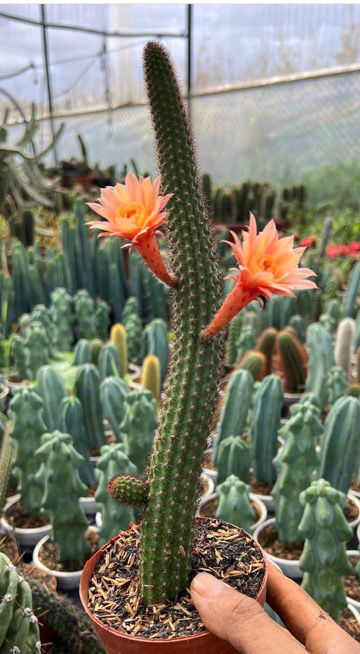
4.1. Echnopsis cactus
🌿 Echinopsis (commonly known as the Easter Lily Cactus, Hedgehog Cactus, or Sea-urchin Cactus) is a celebrated genus of globose to cylindrical succulents in the cactus family, Cactaceae, native to the arid valleys, grasslands, and rocky slopes of South America, including Argentina, Bolivia, Brazil, Paraguay, and Uruguay. In its native habitats, it thrives in stony mineral soils exposed to harsh solar irradiation and dramatic diurnal temperature shifts. It is an outstanding, easy-care houseplant cherished for its sculptural ribbed stem architecture and breathtakingly oversized, nocturnal blossoms.
FUN FACT
The genus name derives from echinos hedgehog or sea urchin, and opsis appearance, a reference to these plants' dense coverings of spines.
FOLIAGE AND GROWTH HABIT
Echinopsis begins life as a solitary, spherical to subglobose cactus that gradually elongates into a stout, cylindrical column measuring 15 to 30 centimetres in height and 10 to 15 centimetres in diameter. The body features 10 to 18 sharp, prominent vertical ribs separated by deep, acute furrows that allow the succulent stem to contract during droughts and expand safely after rainfall. The epidermis is a rich, dark emerald-green to glaucous olive-green with a tough, waxy cuticle. Arranged evenly along the crest of each rib are circular, white-woolly areoles spaced 1 to 2 centimetres apart. Each areole bears a radial cluster of 5 to 15 rigid, needle-like spines measuring up to 2 centimetres long, ranging in color from pale cream to dark horn-brown. Over several years, mature specimens freely produce clusters of small spherical offsets at the base, forming an impressive multi-headed mound.
FLOWER DETAILS
In late spring and mid-summer, mature Echinopsis specimens produce extraordinarily large, funnel-shaped blossoms that dwarf the parent cactus body. The flower tubes emerge from the upper areoles, extending 15 to 25 centimetres in length on hairy, scale-covered stalks before opening into magnificent floral bowls measuring 10 to 15 centimetres across. The blossoms feature multiple concentric whorls of satiny, sharply pointed petals ranging from immaculate white to soft rose-pink, lavender, or pastel cream, centered around a delicate cluster of golden-yellow stamens. Opening in the late afternoon or dusk, the flowers emit a sweet, intoxicating floral perfume designed to attract night-flying sphinx moths, lasting approximately 24 to 36 hours before gracefully fading. Following successful pollination, small hairy, fleshy green to reddish berries develop containing numerous tiny black seeds.
CARE INSTRUCTIONS
- 🌞 Light: Requires maximum direct sunlight for 6 to 8 hours daily. Place on an unobstructed south- or southwest-facing windowsill to maintain deep ribbed stem coloration, stout spine development, and to stimulate summer flowering.
- 💧 Water: Utilize the thorough soak-and-dry method. Drench the root ball during spring and summer only when the substrate has dried out 100%. In late autumn and throughout winter dormancy, keep the plant virtually bone-dry, watering once every 6 to 8 weeks only if the ribs begin to noticeably shrink.
- 🌡️ Humidity: Thrives in low indoor humidity between 20% and 40%. It copes effortlessly with dry indoor Canadian winter heating systems without suffering foliar stress.
- 🪴 Soil: Demands an exceptionally porous, mineral-rich potting mix consisting of 70% pumice, crushed lava rock, coarse perlite, and decomposed granite blended with 30% organic cactus compost for rapid drainage.
- 🏺 Potting: Best cultivated in a heavy, porous terracotta pot equipped with large drainage holes. Terracotta facilitates rapid root-zone evaporation and provides sturdy ballast against top-heavy flowering stems.
- 🌱 Growth rate: Moderate grower for a desert cactus. It steadily increases in stem girth during warm weather while actively producing basal pups and flower buds each season.
- 👩🌾 Fertilizing: Feed once a month from April through July using a low-nitrogen, high-phosphorus cactus fertilizer diluted to one-quarter strength. Never fertilize during the autumn cool-down or winter rest period.
WHERE TO PUT IT
Echinopsis is a showstopper for a bright south-facing windowsill, sun-drenched sunroom, or dedicated cactus shelf where sunlight is brightest. During the active summer period, it welcomes warm room temperatures between 22°C and 32°C. In winter, providing a cool resting location between 8°C and 14°C encourages generous flower bud initiation the following spring. Keep the pot protected from freezing drafts, condensation drips, and high humidity.
