
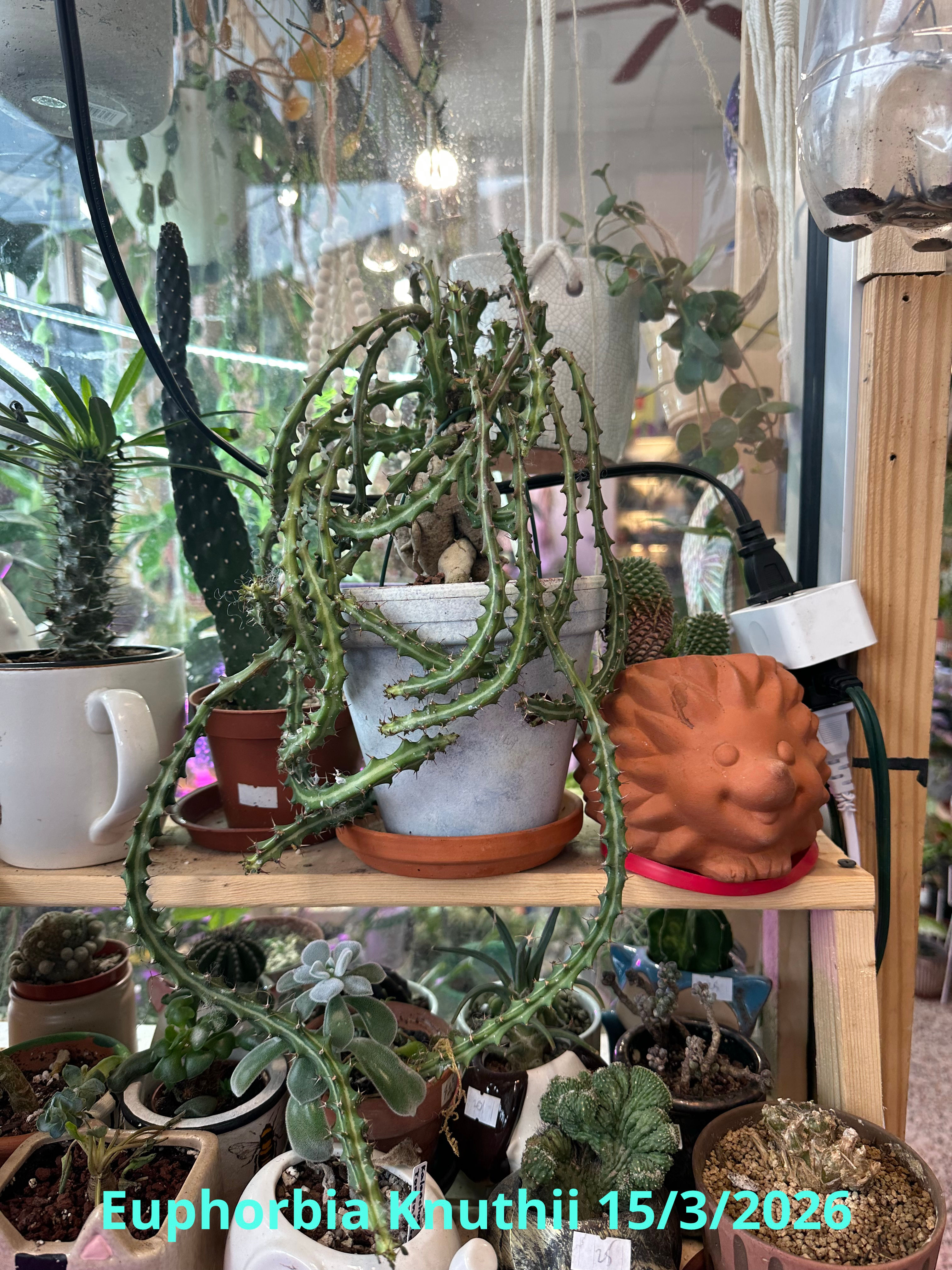

4.1. Euphorbia Knuthii 7717
🌿 Euphorbia knuthii is an exquisite dwarf caudiciform succulent belonging to the Euphorbiaceae family, indigenous to coastal and low-altitude subtropical regions of southern Africa, including KwaZulu-Natal, Mpumalanga, Eswatini, and southern Mozambique. In its native veld, it forms an underground tuberous rootstock that anchors into heavy clay and stony soils, producing tangled crowns of spiny stems. It is an intermediate to collector-level houseplant celebrated by succulent growers for its striking bonsai-like caudex and striped serpentine branches.
FUN FACT
The parent species Euphorbia knuthii was first scientifically described by German botanist Ferdinand Albin Pax in 1904.
FOLIAGE AND GROWTH HABIT
Euphorbia knuthii forms a substantial, fleshy tuberous caudex that can swell up to 10 centimetres in diameter. While primarily subterranean in habitat, indoor collectors intentionally elevate the sculptural caudex above the soil line during repotting to reveal its intricate, gnarled root forms. Sprouting from the top of the caudex are numerous slender, three- to four-angled branches that grow 10 to 20 centimetres in length. The stems showcase an attractive light green epidermis patterned with distinct greyish-green to silvery longitudinal stripes, which can blush with soft reddish-purple hues when grown under intense sunshine. The stem margins are lined with small, tooth-like tubercles bearing paired, needle-sharp brownish spines up to 8 millimetres long.
FLOWER DETAILS
During late spring and summer, mature branches produce small, discrete cyathia that emerge along the angles of the upper stem segments. These floral structures are yellow-green to chartreuse, featuring tiny nectar glands that secrete minuscule droplets of sweet nectar to attract pollinating insects. The flowers are unisexual and minimalistic, devoid of showy petals or sepals. After pollination, the female cyathia develop into small, three-lobed capsules that dry and dehisce, propelling tiny spherical seeds several centimetres away from the parent crown.
CARE INSTRUCTIONS
- 🌞 Light: Prefers bright indirect light to partial direct sunlight for 5 to 7 hours daily. A sunny east- or south-facing window encourages compact internodes and sharp stem striping.
- 💧 Water: Follow the soak-and-dry method. Water deeply during spring and summer when the potting medium has dried out completely. Reduce watering drastically in autumn and keep almost entirely dry during winter rest.
- 🌡️ Humidity: Adapts readily to dry household air with ambient humidity between 35% and 50%. Avoid placing in damp or steamy bathrooms.
- 🪴 Soil: Requires a gritty, highly porous substrate consisting of coarse pumice, perlite, decomposed granite, and peat-free potting loam to ensure rapid moisture runoff.
- 🏺 Potting: Best cultivated in shallow unglazed ceramic or terracotta bonsai pans with generous bottom drainage. Repot only every 2 to 3 years in early spring to inspect root health and elevate the caudex.
- 🌱 Growth rate: Moderate grower for a caudiciform succulent. It readily produces new branch segments during the summer while gradually adding volume to its swollen tuberous base.
- 👩🌾 Fertilizing: Feed monthly during the active spring and summer growing period with a water-soluble cactus fertilizer diluted to one-quarter strength. Cease feeding during autumn and winter dormancy.
WHERE TO PUT IT
Euphorbia knuthii is a showstopping centerpiece for an east- or south-facing windowsill, sunny desk, or plant stand in a well-ventilated living room or study. Keep indoor temperatures between 18°C and 26°C during the growing season, and ensure winter temperatures remain above 10°C. Protect the specimen from freezing window drafts and direct dry heat blasts from baseboard radiators.
