
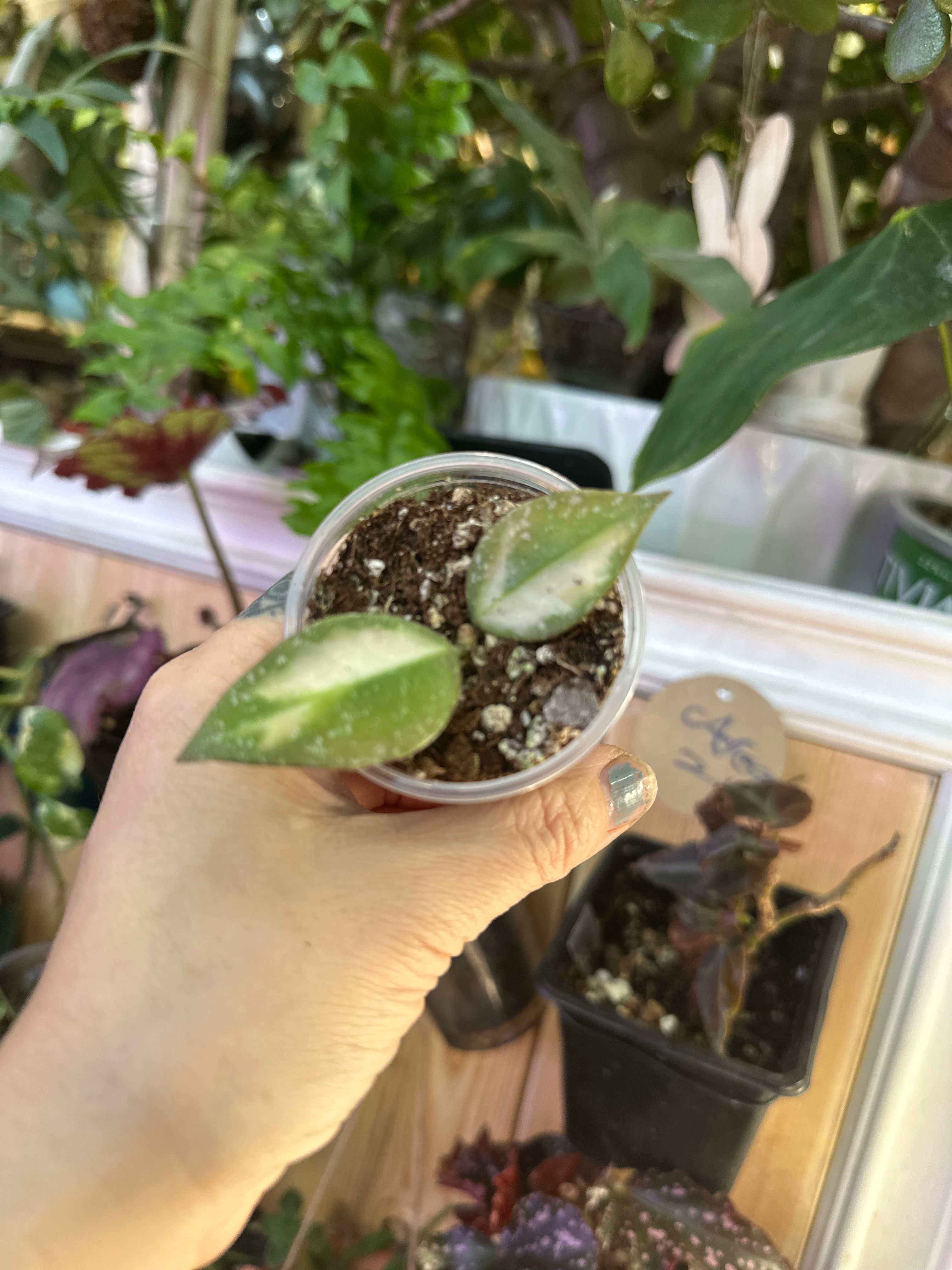

5.N. Hoya Nabawaensis varigated 6478
🌿 Hoya nabawanensis (commonly known as the Variegated Nabawan Wax Plant) is a charming, climbing and trailing epiphytic wax vine belonging to the dogbane and milkweed family, Apocynaceae. It was formally described in 2002 by Dale Kloppenburg and Eva-Karin Wiberg, based on specimens collected near Nabawan in the southwestern interior of Sabah on the island of Borneo, Malaysia. In its native Bornean habitat, it thrives as an epiphyte in humid hill dipterocarp and heath forests, scrambling through low bushes and mossy tree trunks in moist understory environments with sphagnum moss on the forest floor. It is an exceptional, collector-level houseplant, highly sought after by hoya enthusiasts for its compact vining habit, attractive foliar splash and variegation, and sweet-scented floral umbels.
FUN FACT
Hoya nabawanensis commemorates its geographic origins because it was first collected in Nabawan, Sabah, Borneo and this is where the plant gets it name.
FOLIAGE AND GROWTH HABIT
Hoya nabawanensis produces slender, wiry, pale grey-green vining stems that trail gracefully from hanging containers or climb vertical supports using adventitious clinging rootlets. In container cultivation, vines readily reach 1 to 2 metres in length while maintaining an orderly, compact foliar display. The leaves are arranged oppositely along the stems on short, stout petioles measuring 4 to 8 millimetres in length. Each leaf blade is thick, leathery, and ovate-lanceolate to elliptic in outline, measuring 3 to 6 centimetres in length and 1.5 to 2.5 centimetres in width, with an acute apex and rounded base. In this premium variegated selection, the leaves showcase an eye-catching creamy-white to pale butter-yellow center or margin contrasted against deep olive-green borders, often embellished with irregular silvery splash flecks. When exposed to bright, filtered morning light, the variegated tissue frequently blushes with delicate soft pink or rosy tones.
FLOWER DETAILS
Flowering occurs on mature specimens throughout late spring, summer, and early autumn. The inflorescence is a compact, convex to hemispherical umbel suspended on a persistent, slender peduncle that measures 2 to 4 centimetres in length, bearing 15 to 25 petite blossoms. Each star-shaped flower measures approximately 1 centimetre in diameter. The corolla lobes are strongly reflexed, creamy-white to pale blush-pink, and clothed in a dense coating of fine, velvety hairs. At the center of the blossom sits an elevated, star-like corona of creamy-white to soft yellow with pale pinkish centers. The flowers open in the evening and remain open for 4 to 7 days, releasing a gentle, sweet floral fragrance reminiscent of honey and butterscotch. Never prune off the persistent flower peduncles after blooming, as subsequent flower flushes will emerge repeatedly from the same structures.
CARE INSTRUCTIONS
- 🌞 Light: Thrives in bright indirect sunlight with 2 to 4 hours of gentle morning direct sun. Strong indirect light is crucial to maintain sharp contrast in foliar variegation and induce pink sun-blushing without scorching leaf tissue.
- 💧 Water: Allow the top 50% to 75% of the potting medium to dry out thoroughly between waterings. Use the soak-and-dry method during active spring and summer growth, and reduce watering frequency in winter when cooler temperatures slow metabolic activity.
- 🌡️ Humidity: Prefers moderate to high ambient humidity between 50% and 75%. It adapts well to normal indoor household humidity, though higher humidity encourages faster foliar growth and easier peduncle development.
- 🪴 Soil: Demands an open, chunky, highly aerated epiphytic hoya mix composed of 40% medium orchid bark, 25% coarse perlite, 20% coconut husk chips, 10% pumice, and 5% horticultural charcoal to prevent moisture compaction.
- 🏺 Potting: Best suited for a snug plastic nursery container or clear orchid pot with ample drainage slits. Hoyas thrive and flower most abundantly when their root systems are slightly root-bound.
- 🌱 Growth rate: Moderate grower during warm months, steadily extending fresh vining shoots, developing paired variegated leaves, and setting flower spurs.
- 👩🌾 Fertilizing: Feed once every 3 weeks from April through September using a balanced, water-soluble orchid or hoya fertilizer diluted to one-quarter strength. Withhold fertilization during late autumn and winter.
WHERE TO PUT IT
Hoya nabawanensis makes a delightful display in a hanging basket near an east-facing window, or trained upon a small bamboo hoop or wire trellis on a bright living room shelf. Maintain stable indoor room temperatures between 19°C and 27°C throughout the year, ensuring the plant is never subjected to temperatures below 15°C. Position the pot away from cold winter window drafts and hot forced-air heating vents. Handle the vines gently when training to prevent damage to emerging peduncles.
