
5 Bizarre Houseplant Secrets: Camouflage Patterns, Blue Velvet Leaves & Bug-Eaten Mimicry (Part 3 of 5)
In Part 1 and Part 2 of our botanical curiosity series, we unmasked hurricane-venting Monsteras, leafless flower-powered Hoyas, and Staghorn ferns that brew their own homemade compost.
Today, welcome to Part 3. Deep inside tropical cloud forests and misty volcanic slopes, survival is a high-stakes chess match against predatory insects and perpetual shadow. From military pixel camouflage to cellular mirrors and metallic blue photon traps, here are 5 mind-blowing botanical secrets hidden right inside our collection at Orange's Home.
1. Philodendron Joepii: The Master of 'Bug-Eaten' Mimicry
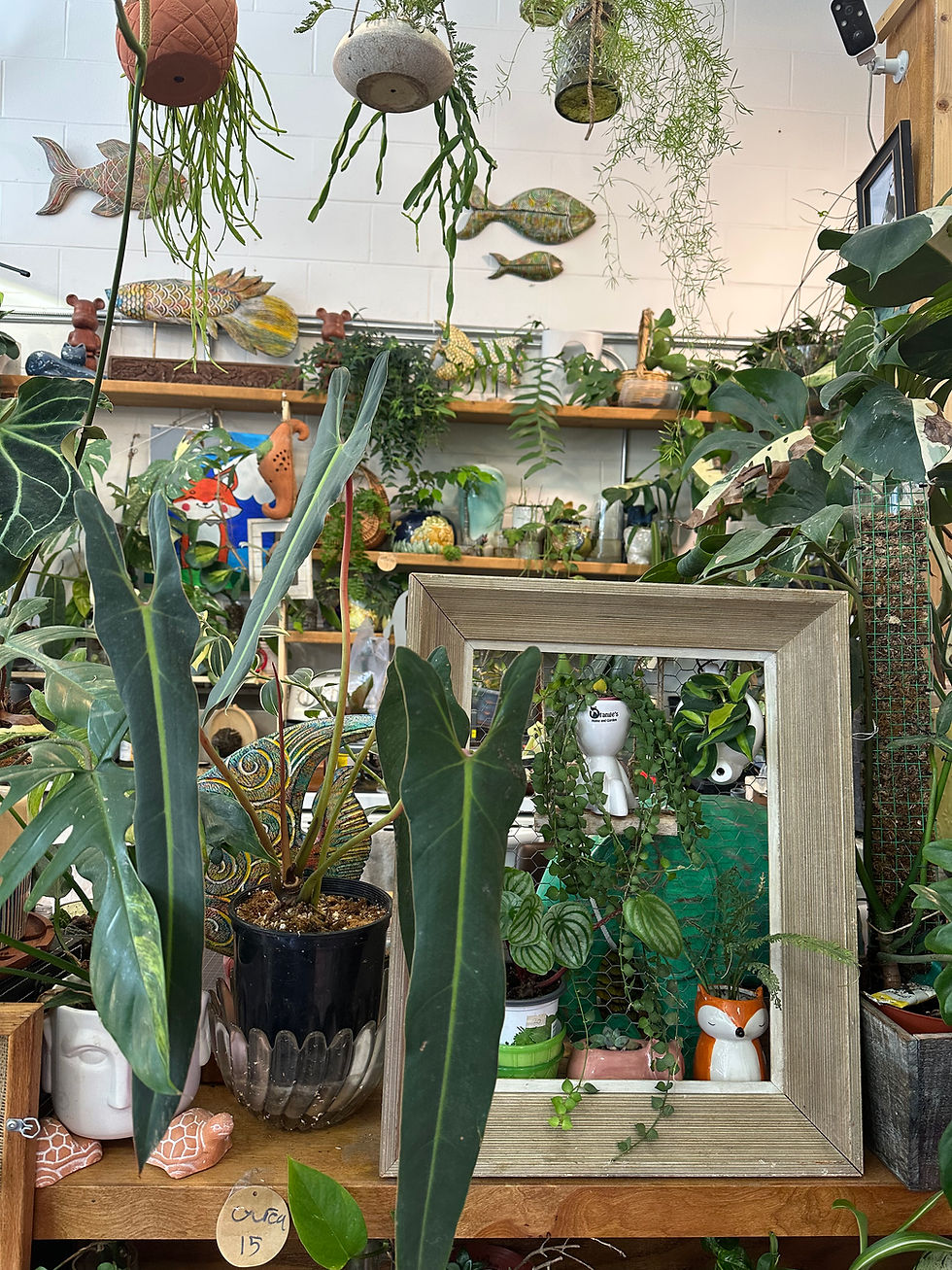
When you first lay eyes on Philodendron Joepii, your instinct might be to look for a giant pest infestation. Each mature leaf looks as though a famished caterpillar took massive bites out of both sides, leaving a bizarre, ultra-narrow waist with winged lower lobes and a paddle-shaped tip.
First discovered on the Mataroni River in French Guiana by naturalist Joep Moonen in 1991, this plant is not deformed. Evolutionary biologists hypothesize this shape is a brilliant defense mechanism known as herbivore-damage mimicry. By unfurling leaves that already look devoured, grazing canopy caterpillars and insects are fooled into passing over the foliage in search of undamaged, nutrient-rich leaves. Furthermore, the slender waist reduces aerodynamic drag in fierce rainstorm winds.
2. Aglaonema Pictum Tricolor: Real Army Camouflage Grown by Nature
If you have ever seen an army uniform and thought military designers invented disruptive camouflage, nature beat them by millions of years. Look at Aglaonema Pictum Tricolor: its leaves look hand-painted with crisp pixelated patches of deep forest green, bright lime, and frosted silver-white.
Native to the volcanic slopes of Sumatra (such as Mount Singgalang and Mount Nago), this plant grows on damp, rocky forest floors under dappled canopy light. The contrasting three-color mosaic is classic disruptive coloration: it breaks up the continuous outline of the leaf against shadows and fallen volcanic gravel, making it virtually invisible to browsing herbivores. What looks eye-catching on your indoor plant shelf is total stealth in the wild.
3. Begonia Pavonina: The Peacock That Glows Electric Blue in the Dark
Place Begonia Pavonina under direct sunlight and you might see a moody, dark bronze-green leaf. But move it into dim ambient light and view it from an angle: the foliage suddenly flashes an iridescent, electric metallic cobalt blue.
This is not a pigment trick; it is quantum physics inside living tissue. Growing in near-total darkness at the base of Malaysian mountain ravines, Begonia pavonina evolved specialized chloroplasts called iridoplasts. Inside these cells, thylakoid membranes are stacked in precise, microscopic periodic layers that act as a photonic crystal. They reflect useless blue light (causing the blue glow) while slowing down green and red light waves by approximately 10%. This allows the leaf to squeeze 5% to 10% more photosynthetic energy from low-level photons that other plants simply cannot absorb.
4. Anthurium Pallidiflorum: The Cloud Forest's Living Velvet Necktie
Most plant lovers picture anthuriums as upright plants with stiff heart-shaped leaves and bright plastic-like spathes. But in the steep cloud forests of Ecuador, Anthurium Pallidiflorum turned the family tradition completely upside down.
Pallidiflorum is a true pendant epiphyte, growing high on mossy tree branches with narrow, shimmering velvet strap leaves that cascade straight down like silk neckties, often reaching over 1 meter (3 feet) in length. Hanging vertically is vital cloud forest engineering: continuous mountain mists run straight off the narrow tips without pooling, preventing fungal rot and eliminating heavy water weight that could tear the roots from the tree bark.
5. Scindapsus Pictus Exotica: The Silver Mirrors That Don't Use Pigment
Popularly known as the Satin Pothos, Scindapsus Pictus Exotica captivates plant parents with its plush frosted silver splashes. But if you examined the leaf under a microscope, you would find zero white or silver pigments.
This optical effect is called blister variegation. During leaf development, microscopic air pockets form between the transparent upper epidermis and the green photosynthetic palisade layer below. These pockets of air reflect ambient light like miniature mirrors. This gives the plant its shimmering satin shield to deflect intense canopy rays while keeping 100% of the green tissue underneath healthy and fully photosynthetic.
Which of these evolutionary masterpieces surprised you most? Stay tuned for Part 4 of our botanical discoveries series, or explore the Orange's Home online shop to bring a living piece of jungle evolution into your Canadian home today!


Comments